
Searching the Piedmont Court Docket
For a city citation, begin with the official Piedmont Municipal Court page. It lists current contacts and any payment route the city has authorized. Be careful, though. A payment screen only shows what you owe, not the full story of the case. Unless it lists court events, treat it as a bill, not a docket. Need a confirmed hearing date? The municipal clerk is still the one to call. The clerk can also supply a filed copy of anything.
- Read the court, agency, citation number, and appearance date on the original notice.
- Use the official Piedmont page or linked vendor for a Piedmont city citation.
- Enter the exact ticket number and matching details when a lookup requests them.
- Call or visit the municipal clerk when no result appears or appearance is required.
- Move to Alabama case access or the Calhoun courthouse terminal for a District or Circuit case.
Check the case number, charge, court, and date on any Piedmont docket entry before trusting a blank result.
Piedmont Municipal Court Channel
Piedmont Municipal Court handles city ordinance violations, municipal misdemeanors, and traffic tickets inside city limits. Its records live on a separate channel from the Calhoun County Circuit Clerk. The same goes for Alacourt, the statewide service. So a citation written on the Piedmont city docket belongs with the city clerk. That is where a search should begin. For the court's own details, the official municipal court page lists what the city publishes.
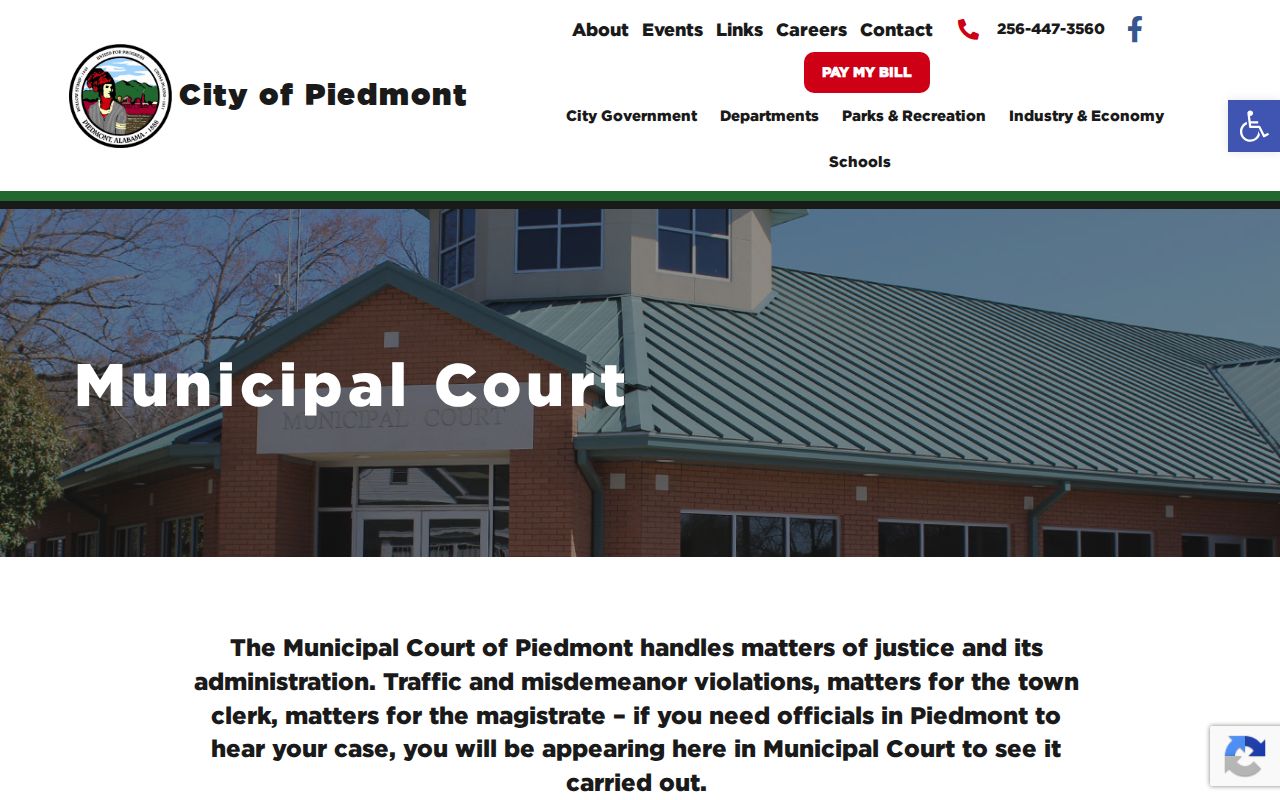
That page points you to the right local channel. The clerk, though, keeps the filed case record and any current court date, so confirm the setting there.
Piedmont Municipal Court Basics
Felonies never finish in Piedmont's municipal courtroom. That court has no general felony or civil jurisdiction at all. State misdemeanors, preliminary felony proceedings, and state or county traffic tickets belong in District Court. Indicted felonies and general-jurisdiction cases travel to Circuit Court.
Piedmont also crosses county lines. Living inside the city does not tell you which county's docket holds your case. Check the citation or filing for the issuing agency, the named court, and the county. The official City of Piedmont site offers current city access. It is not a case action summary, though.
Piedmont Court Sessions and Office Hours
A small city like this one often runs its court on periodic sessions while the administrative office keeps separate hours. City office hours are not court dates, so never guess a setting from them. Before any visit, recheck the municipal page for the current address, phone, hours, judge, and session schedule, then match that against the appearance date printed on the citation.
Timing matters: A clerk counter may be open when court is not in session, and a scheduled session may use hours unlike ordinary city business hours.
A quick call can confirm your date and how to get in. It cannot change a setting, though. Only a valid reset or order from the court does that.
Court Dates and Settings in Piedmont
A Piedmont court date can surface in many places. You might find it on a citation, a summons, a vendor result, a clerk notice, or a later order. Trust the newest valid court record above the rest. After a continuance, earlier dates can still sit in the docket history.
| Date | The appearance day shown on the latest effective notice. |
|---|---|
| Time | The court-session or docket-call time, not always an individual slot. |
| Courtroom | The municipal location or county courtroom tied to the filed case. |
| Judge | The assigned judicial officer when listed. |
| Setting Type | Arraignment, pretrial, trial, review, or another stated hearing. |
If two sources disagree on a date or setting, call the clerk who holds the case. Have your citation number and the most recent notice handy when you phone or come to the counter.
Piedmont City and County Citations
A ticket written by Piedmont officers goes to Municipal Court. A citation under state or county authority moves to District Traffic when Calhoun County is the filing county. What matters is the issuing authority on the ticket itself, not the driver's home address.
| Source | Likely custodian | First check |
|---|---|---|
| Piedmont city authority | Piedmont municipal clerk | Official city court page |
| Alabama State Trooper | District Court clerk | Printed county and state portal |
| County authority | District Court clerk | Calhoun District Traffic if named |
Piedmont sits in two counties, so verify the county along with the court. Guessing from the name alone can send your docket request to the wrong clerk.
Traffic Tickets in Piedmont
Pay through an authorized city vendor only if the official Piedmont court page links you there. Write down the citation number and the matching identity details. Add the amount, your payment method, and a confirmation. Paying resolves an eligible ticket; to fight it, you must use the court's hearing route. A mandatory appearance cannot be bought out without authorization.
No result online? Recheck the number, confirm the court, then call the clerk. The file may not be loaded yet. It may require an appearance, or may belong to District Court. The Calhoun traffic ticket page walks through the state and county route.
A court traffic record shows the citation, plea, settings, disposition, and costs. A payment receipt covers less, and a driver record sits with a different state office.
Piedmont Payment and Certified Disposition
Paying is not the same as closing the case. A portal can confirm a transaction yet never supply the signed disposition or a clerk seal. When you need exact proof of the outcome, ask Piedmont’s clerk for the filed disposition itself.
- Payable status
- The court permits the ticket to be resolved through an approved payment method.
- Mandatory appearance
- The court requires the person to appear or act directly.
- Disposition
- The recorded conclusion of the charge.
- Certified copy
- A clerk-authenticated reproduction of the official record.
Have your citation number, party name, and the case date ready, plus the name of the document you want. Ask the clerk for the current cost, the delivery options, and whether any information must be redacted.
Where Piedmont Cases Go
A Piedmont municipal case starts in city court. Where Alabama law applies, it can be appealed to Circuit Court for a new trial. State misdemeanors and preliminary felony matters go through District Court, while felony cases move to Circuit Court after indictment.
Docket flow: Piedmont Municipal Court › Calhoun County Courts › Circuit Court
The city case and the later county case may carry distinct numbers and separate histories. Search the municipal record first for the original decision. Then check the Circuit docket for any appeal. The Calhoun County Circuit Clerk holds both District and Circuit records, though not the original city file.
When Piedmont Shows No Result
A blank result on a Piedmont docket search usually means the channel, not the case. Check every digit of the case number, and note which court the ticket actually names. If it points somewhere other than Piedmont Municipal Court, that is your answer. Call the clerk before the date printed on the ticket. Do not wait for the portal to update.
- Keep the citation and any confirmation screen.
- Ask the Piedmont clerk whether the matter is filed and payable.
- Confirm the current appearance date and session location.
- Use the counter or written city request for the docket or disposition.
- Use the county terminal if the paper identifies Calhoun District or Circuit Court.
Just One Look and Alacourt are paid state-court products. They are not free, and they serve the state trial courts rather than the city. AlaFile is the filing application, not the ordinary public search.
Piedmont Court Record Access Rules
Piedmont public records have several doors. The city page, clerk phone, in-person counter, and written municipal request all work. A Calhoun County case adds the courthouse public terminal, Just One Look, Alacourt, and written Circuit Clerk requests. Access always depends on the record's legal status.
Key Rules:
Ala. Code § 36-12-40 establishes a general inspection right subject to exceptions.
Rule 33 preserves inspection and paid copying at Circuit Clerk offices.
Alabama privacy rules protect identifiers and permit court-ordered sealing.
Juvenile, adoption, mental-proceeding, youthful-offender, sealed, and other confidential records may be withheld or limited.
Requesting a Piedmont Case Copy
Ask the Piedmont municipal clerk for a city filing, order, or disposition. Give the case or citation number, the party name, an approximate date, the charge, and the exact document. Say whether certification is required. Current fees and turnaround times should come from the clerk.
The official Piedmont city site lists local offices and the ways to reach them.

The city site points you to local offices. The court clerk, though, keeps every filed municipal record. When the document belongs to Calhoun District or Circuit Court, the request goes elsewhere. Send it to the Calhoun County Circuit Clerk at 25 West 11th Street, Anniston, Alabama 36201.
Reading a Piedmont Docket Entry
On a Piedmont docket, the same word does two jobs. A court-session docket is the list of matters scheduled for one session. A case action summary is the event history for a single case. A payment screen is thinner than either. It can show an amount and a transaction status without providing either full record.
Start with the case number, court, charge, and status. Read the events by date. Watch for a later reset that replaces an earlier appearance. A short label like “Order” confirms an order was entered. The full document may still need to be requested. Confirm costs with the clerk before sending funds.
Common labels each carry their own weight. A setting is a planned court event. A continuance moves that event. A plea records the response to a charge, and a disposition records how the matter concluded. An image link may lead to the document behind an entry. Public access to that image is not assured. When a brief label cannot answer the question, ask for the actual filing.
For a certified outcome, request the actual disposition and certification from the court that decided the matter. The Piedmont clerk handles city files. The Calhoun County Circuit Clerk handles District and Circuit records. Keep those two separate. That prevents a payment receipt or calendar result from being mistaken for the official case record.
Older or restricted material may not appear on the first search. Recheck the court level first. Then ask the clerk whether the file is archived or covered by a confidentiality rule. A missing result is a reason to contact the clerk. It is not proof the matter never existed.
Piedmont Docket Search Across Court Levels
Piedmont sits across county lines. So the named court matters more than the city label. Check the citation or summons. It should show which court received the matter and which county is involved. A Piedmont municipal citation belongs with the city clerk. A Calhoun state or county citation belongs with District Court, while a matter filed on the other side of the city boundary must be sought in the county actually named.
The courthouse public terminal supports a free name search during clerk hours. Just One Look sells case-by-case access. Alacourt is a read-only subscription service. AlaFile is a filing and service system for registered users, not a general public docket reader. None of these products replaces the Piedmont municipal clerk for the city file.
Use the case number when one is available. Then compare the court, case type, filing date, status, and most recent setting. A prior date can linger after a reset. A payment result confirms an eligible transaction. It does not show the text of a filed order. When the full record matters, request the case action summary, disposition, or other named document from the responsible clerk.
If a Piedmont case is appealed, the original municipal record and the Circuit Court case remain distinct. The municipal file shows the city proceedings and original disposition. The later Circuit docket records the appeal and new trial process. Search both levels to reconstruct that path.